The Science of Scalp Renewal: How Topical GHK-Biotin Peptide Transforms Hair Growth From the Inside Out
There is a quiet revolution happening at the scalp level — one that has nothing to do with harsh pharmaceuticals, hormonal disruption, or invasive procedures. It begins with a peptide. Specifically, it begins with the extraordinary synergy of GHK and biotin — two molecules that, when fused into a single topical compound and applied directly to the scalp, initiate a cascade of cellular events that can visibly transform the quality, density, and vitality of hair.
At I'm Fabulous Cosmetics, we have long believed that the most intelligent skincare — and haircare — begins at the biological level. Our GHK-Biotin Hair Growth Serum is not a cosmetic gimmick. It is a precision-formulated, science-led treatment grounded in decades of peptide research and born from the same philosophy that drives every product in our luxury organic collection: that the body knows how to regenerate, and the right molecule, delivered at the right concentration, can unlock that innate intelligence.
This article is for the woman or man who is done with surface-level solutions. It is for the discerning individual who wants to understand — truly understand — why their hair is thinning and what, on a cellular and biochemical level, can be done about it. What follows is an in-depth exploration of GHK-Biotin peptide science, its mechanisms of action on the scalp, and why topical application via a premium serum represents the most elegant and effective approach to hair restoration available today.

What Is GHK-Biotin, and Why Does It Matter for Hair?
The story of GHK begins in the 1970s, when biochemist Loren Pickart first isolated the glycyl-L-histidyl-L-lysine tripeptide from human plasma. This small, naturally occurring molecule — composed of just three amino acids — demonstrated a remarkable and somewhat unexpected ability: it seemed to signal aged liver tissue to behave more like young liver tissue. In the decades that followed, research expanded to reveal that GHK is not merely a healing peptide but a master biological regulator capable of influencing thousands of genes related to tissue repair, anti-inflammation, collagen synthesis, and cellular regeneration.
What makes the GHK-Biotin complex particularly compelling in the context of hair growth is the marriage of two distinct biological pathways. GHK (often delivered as its copper-bound form, GHK-Cu, or in its biotinylated variant known as Biotinoyl Tripeptide-1) brings its powerful regenerative and signaling capabilities to the hair follicle microenvironment. Biotin — the B-vitamin long recognized for its role in keratin infrastructure — contributes structural reinforcement at the follicular level, supporting the synthesis of the very protein from which hair is made.
Together, these two components create a topical compound that works both upstream and downstream of hair production: stimulating the follicle to produce, while simultaneously building the molecular scaffolding that makes strong, resilient hair possible.

Understanding Hair Loss: The Biological Context
To appreciate the significance of GHK-Biotin, one must first understand why hair loss occurs at all. Hair loss is not a single event but the culmination of multiple converging biological failures — a breakdown of circulation, hormonal balance, inflammatory control, and stem cell signaling happening simultaneously within the same microscopic organ: the hair follicle.
Each hair follicle is a dynamic mini-organ, cycling through three distinct phases: the anagen phase (active growth, lasting two to six years), the catagen phase (a brief transitional period), and the telogen phase (rest, during which the hair sheds). In a healthy scalp, the vast majority of follicles are in the anagen phase at any given time. In a compromised scalp — one affected by age, hormonal shifts, oxidative stress, inflammation, or nutrient deficiency — follicles spend increasing amounts of time in the telogen phase and decreasing amounts of time in anagen. The result is progressively thinner, shorter, and less dense hair.
Compounding this cycle disruption is the issue of follicle miniaturization. Under the influence of dihydrotestosterone (DHT), follicles gradually shrink, producing increasingly fine and colorless hair until they cease producing entirely. Chronic scalp inflammation, poor microcirculation, and the accumulation of free radical damage accelerate this process significantly.
What the GHK-Biotin peptide complex addresses — elegantly and on multiple fronts — is precisely this multi-factorial breakdown.

The Cellular Mechanisms: How GHK-Biotin Works on the Scalp
Extending the Anagen Phase Through Growth Factor Modulation
One of the most significant and well-documented actions of GHK-Cu class peptides on the scalp is their ability to modulate the cytokines and growth factors that govern the hair cycle. Research has demonstrated that GHK-type peptides can downregulate transforming growth factor-beta 1 (TGF-β1), a cytokine implicated in premature follicle regression and the shift from anagen to catagen. By suppressing TGF-β1 activity, topical GHK-Biotin may effectively prolong the growth phase of each follicle — meaning each hair grows longer, denser, and for a greater period before shedding.
Simultaneously, GHK-Biotin has been shown to stimulate the production of vascular endothelial growth factor (VEGF) and basic fibroblast growth factor (bFGF), two of the most critical growth factors in follicular biology. VEGF drives angiogenesis — the formation of new blood vessels — which directly improves the delivery of oxygen and nutrients to the follicle's dermal papilla cells. bFGF supports the proliferation of the hair matrix cells responsible for active hair shaft production. The combined upregulation of these factors creates an internal environment in which hair follicles are not merely surviving, but actively thriving.
Stimulating Dermal Papilla Cell Proliferation
The dermal papilla is the command center of the hair follicle — a specialized cluster of mesenchymal cells at the base of the follicle that signals to the surrounding matrix cells to produce hair. The health, size, and signaling capacity of the dermal papilla determines virtually everything about hair quality: its diameter, its pigmentation, its growth rate, and its ultimate lifespan.
Studies on human dermal papilla cell cultures have shown that GHK-type copper peptides can stimulate cell proliferation within the papilla while reducing apoptotic (cell death) signaling. A larger, more metabolically active dermal papilla produces thicker, more robustly pigmented, and faster-growing hair. This is not merely theoretical — research published in the International Journal of Cosmetic Science documented increased hair density and reduced shedding in participants using topical copper peptide complexes, with the improvements correlating with measurable changes in follicular architecture.

Rebuilding the Follicular Extracellular Matrix
Hair does not grow in a vacuum. The follicle is embedded within an extracellular matrix (ECM) — a complex scaffolding of proteins including collagen, laminin, and fibronectin — that provides structural support, facilitates cellular communication, and delivers biochemical signals essential to follicular function. As the scalp ages, this matrix degrades. Collagen production declines. Laminin synthesis slows. The structural integrity of the follicle's immediate environment erodes, and with it, the follicle's ability to cycle normally.
GHK peptides are among the most potent known stimulators of collagen synthesis in topical applications, with laboratory research suggesting increases in collagen production of up to 70% under GHK-Cu influence. But equally relevant to hair growth is GHK's documented ability to stimulate the production of Laminin-5 (also known as Laminin-332) and Collagen IV — two structural proteins that are essential components of the basement membrane surrounding each hair follicle. Greater Laminin-5 and Collagen IV production directly translates to stronger follicular anchoring, improved hair shaft integrity, and more robust hair growth overall.
The biotin component of the GHK-Biotin complex reinforces this structural activity by supporting keratin biosynthesis. Keratin, the primary protein of the hair shaft, requires biotin as a cofactor in its synthesis pathway. When biotin is delivered directly to the scalp — rather than relying on systemic absorption from an oral supplement — it becomes available precisely where it is needed most: at the follicle itself.

Activating Wnt/β-Catenin Signaling
Among the most exciting recent discoveries in the science of GHK peptides and hair growth is their potential interaction with the Wnt/β-catenin signaling pathway. This pathway is one of the most fundamental regulatory networks in developmental biology, playing a critical role in hair follicle morphogenesis, stem cell activation, and the initiation of new hair growth cycles. Emerging research — including studies using advanced ionic liquid microemulsion delivery systems for GHK-Cu — has demonstrated that copper peptide application can activate Wnt/β-catenin pathway components and their key proteins, promoting both the differentiation and proliferation of hair follicle epithelial cells.
The implications of this finding are profound. The Wnt/β-catenin pathway is essentially the "on switch" for follicular stem cells residing in the bulge region of the hair follicle — dormant cells that, when properly stimulated, can initiate entirely new hair growth cycles. The possibility that topical GHK-Biotin may be capable of awakening these stem cells and triggering new anagen phases in follicles that have entered a prolonged resting state represents one of the most compelling arguments for its use in addressing progressive hair thinning and early-stage alopecia.

Improving Scalp Microcirculation
A well-oxygenated, nutrient-rich blood supply is foundational to healthy hair growth. The dermal papilla cells at the base of each follicle are among the most metabolically active cells in the human body — they require a continuous and robust supply of oxygen, glucose, amino acids, and micronutrients to maintain their prodigious cell-signaling and proliferative activity. In a scalp with compromised microcirculation — a condition far more common than generally recognized, and one that accelerates significantly with age — follicles are progressively starved of these essentials, leading to miniaturization and cycle disruption.
GHK-Biotin's demonstrated capacity to promote angiogenesis and stimulate the production of VEGF means that consistent topical application may improve the density and functional capacity of the capillary network supplying each follicle. Better blood flow means better nutrient delivery. Better nutrient delivery means more metabolically active dermal papilla cells. More active papilla cells mean healthier, faster-growing, denser hair. The logic of this cascade is elegant in its simplicity and compelling in its clinical implications.
Anti-Inflammatory Protection of the Follicle
Chronic low-grade scalp inflammation is one of the most underappreciated drivers of hair loss. Whether triggered by DHT sensitivity, sebaceous gland hyperactivity, oxidative stress, environmental aggressors, or autoimmune dysregulation, inflammation around the hair follicle creates a hostile microenvironment in which normal follicular cycling cannot be sustained. Over time, persistent follicular inflammation contributes to progressive miniaturization and, in its most severe expression, irreversible fibrosis of the follicular unit.
GHK peptides are potent anti-inflammatory agents. Their mechanism in this context involves the downregulation of pro-inflammatory cytokines — including interleukin-1 alpha and tumor necrosis factor — that directly damage follicular epithelium and disrupt the dermal papilla's signaling function. By modulating the inflammatory milieu of the scalp, GHK-Biotin helps to restore a physiological environment in which hair follicles can cycle normally, free from the chronic insult of inflammatory damage.
This anti-inflammatory capacity also makes GHK-Biotin particularly valuable for those experiencing diffuse hair loss associated with scalp conditions such as seborrheic dermatitis, psoriasis, or stress-induced telogen effluvium — conditions in which the inflammatory component is central to the clinical presentation.
Antioxidant Defense and the Aging Scalp
Oxidative stress — the accumulation of reactive oxygen species (ROS) in excess of the body's antioxidant defenses — accelerates virtually every aspect of biological aging, including hair follicle aging. ROS damage the mitochondria of dermal papilla cells, disrupt the ECM, accelerate collagen degradation, and impair the DNA repair mechanisms that keep follicular stem cells healthy and functionally active. The result, over years of cumulative exposure, is a scalp that is prematurely aged at the cellular level: thinner, drier, less vascular, and less capable of sustaining robust hair growth.
GHK demonstrates measurable antioxidant activity, enhancing the body's endogenous defenses against oxidative damage within the scalp tissue. Research points to GHK's capacity to upregulate superoxide dismutase and catalase — two of the primary enzymatic antioxidants responsible for neutralizing the most damaging categories of free radicals. This antioxidant reinforcement, applied topically and consistently, helps preserve the integrity of follicular stem cells and the ECM, slowing the cellular aging of the scalp in ways that directly translate to sustained, healthy hair growth over time.

GHK-Biotin Versus Conventional Hair Loss Treatments
The context for understanding GHK-Biotin's significance is incomplete without acknowledging the limitations of the conventional options that currently dominate the hair loss treatment landscape. Minoxidil, the topical vasodilator that has remained the standard of care for androgenetic alopecia for decades, works primarily by extending the anagen phase and improving scalp circulation — the same mechanisms, incidentally, that GHK-Biotin addresses through more biologically nuanced pathways. Research published in Bioactive Materials explicitly characterized copper peptides as a powerful hair growth promoter with minimal side effects when compared with both minoxidil and finasteride, while also noting that GHK-Cu promotes hair growth by accelerating the hair follicle growth cycle through multiple synergistic mechanisms.
Finasteride, a 5-alpha reductase inhibitor that reduces DHT production, addresses the hormonal component of androgenetic alopecia but carries a well-documented profile of systemic side effects including sexual dysfunction, mood disturbance, and — in a subset of patients — persistent post-treatment syndrome. It is not appropriate for women, and its mechanism of action is inherently limited to hormonal pathways, leaving the inflammatory, vascular, and structural components of hair loss unaddressed.
GHK-Biotin operates across all of these domains simultaneously — vascular, structural, inflammatory, and regenerative — without hormonal interference, without systemic side effects, and without the risk profile associated with pharmaceutical intervention. For those who prefer a sophisticated, biology-aligned approach to hair health, it represents a compelling alternative and a powerful complement to any existing hair wellness protocol.

The Decline of Natural GHK: Why Topical Application Becomes Essential With Age
One of the most critical pieces of context for understanding why GHK-Biotin topical serums are not merely beneficial but increasingly essential is the documented age-related decline of GHK in the human body. Research has established that plasma levels of GHK drop precipitously over the course of a lifetime — from approximately 200 nanograms per milliliter at age 20 to around 80 nanograms per milliliter by age 60. This more than 50% decline in the body's principal tissue-regenerating peptide correlates directly with the decreased healing capacity, diminished collagen production, and compromised follicular function that characterize aging skin and scalp.
In other words, the biological infrastructure that once maintained thick, rapidly-growing, lustrous hair without any conscious effort becomes progressively depleted over time. Topical application of GHK-Biotin is not an attempt to override the body's natural processes — it is a means of replenishing a molecule that the body itself once produced in abundance, delivered precisely where it is needed, at the tissue level, bypassing the absorption and bioavailability challenges inherent in oral supplementation.
This is the philosophical foundation of advanced peptide skincare and haircare: not intervention, but intelligent replenishment.
How to Use the I'm Fabulous Cosmetics GHK-Biotin Serum for Maximum Results
The application of a GHK-Biotin serum to the scalp is a practice that rewards consistency and precision. As with all advanced peptide treatments, the most significant results emerge not from a single dramatic application but from the cumulative effect of regular use over weeks and months — a biological investment whose returns compound with time.
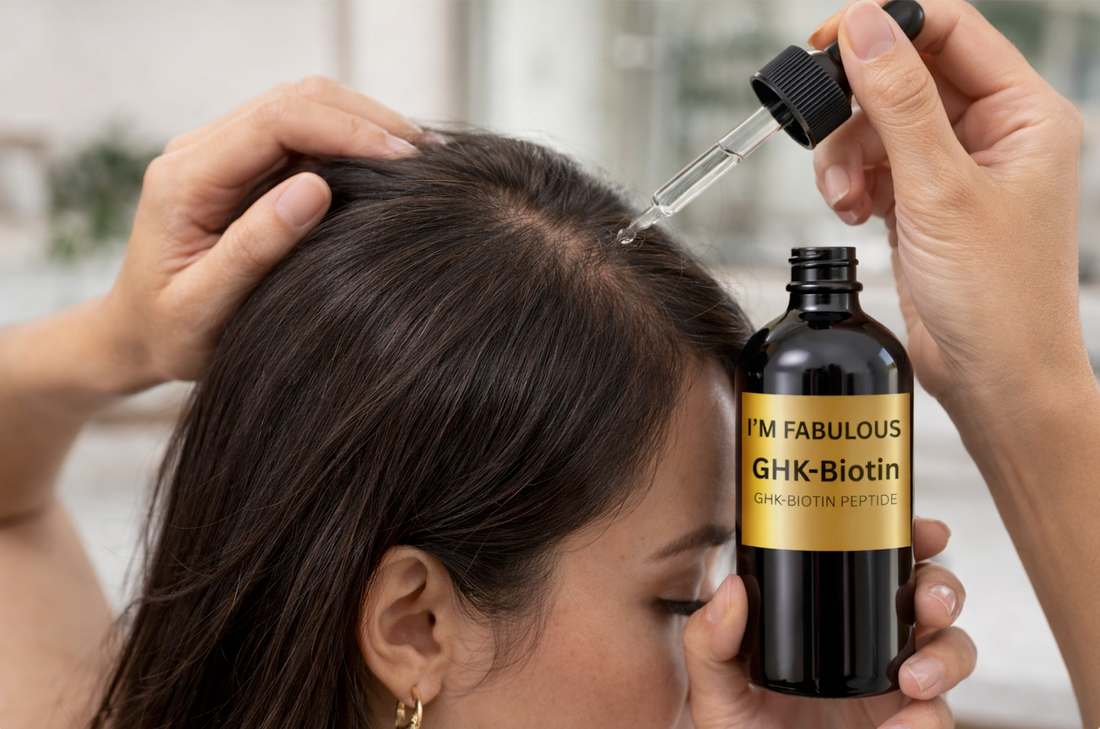
For optimal results, apply several drops of the I'm Fabulous Cosmetics GHK-Biotin Hair Growth Serum directly to the scalp, parting the hair to ensure direct skin contact rather than product resting on the hair shaft. Use the fingertips to massage the serum gently into the scalp in circular motions, encouraging microcirculation and facilitating peptide penetration. The serum is best applied to a clean, freshly washed scalp, ideally in the evening to allow the active peptide complex to work undisturbed overnight.
For those incorporating microneedling into their hair growth protocol — a practice that has gained considerable clinical support for its ability to stimulate scalp regeneration and dramatically improve topical ingredient penetration — GHK-Biotin serum should be applied immediately following the needling session, when the microchannels created by the device allow the peptide complex to penetrate far more deeply into the follicular unit than would otherwise be possible. Clinical observations have consistently documented that the combination of microneedling and copper peptide application produces synergistic results, with improvements in hair count, density, and shaft diameter that exceed either modality used in isolation.
Results should be evaluated over a minimum three-month period, as the hair follicle cycle does not respond instantaneously to even the most potent biological stimuli. Those who approach GHK-Biotin therapy with realistic expectations and genuine commitment will find, at the three-month mark and beyond, a scalp that is visibly healthier, hair that is measurably thicker and denser, and a restoration of the luminous vitality that characterizes truly well-nourished, peptide-supported hair.
Who Benefits Most From GHK-Biotin Topical Therapy
The profile of individuals for whom GHK-Biotin topical therapy is most appropriate is broad, reflecting the peptide complex's multi-mechanistic approach to scalp health. Those experiencing the gradual onset of androgenetic alopecia — diffuse thinning at the crown, recession at the temples, or a general reduction in hair density — will find in GHK-Biotin a non-hormonal, biologically sophisticated intervention capable of addressing multiple contributing factors simultaneously.
Women navigating the hormonal transitions of perimenopause and menopause, during which the decline of estrogen accelerates follicular miniaturization and disrupts the anagen-telogen balance, stand to benefit particularly from the anti-inflammatory, growth-factor-stimulating, and ECM-rebuilding properties of GHK-Biotin. The scalp, like the skin, undergoes measurable collagen loss and vascular compromise during this transition — precisely the deficits that GHK-Biotin is best positioned to address.
Those experiencing stress-induced telogen effluvium — a condition in which acute or chronic psychological stress triggers a mass shift of follicles into the resting phase, resulting in significant diffuse shedding — will find that GHK-Biotin's anti-inflammatory and growth-factor-modulating properties help normalize the disrupted hair cycle and restore healthy anagen-dominant follicular activity.
Even those with no current experience of hair loss who wish to maintain the density, diameter, and vitality of their hair as they age will find in regular GHK-Biotin serum use a powerful preventative measure: a means of continuously replenishing the scalp's biological machinery before the visible consequences of its decline have an opportunity to manifest.
The I'm Fabulous Cosmetics Commitment to Peptide Excellence
Every product in the I'm Fabulous Cosmetics collection — from our celebrated GHK-Cu Copper Peptide Serum to our transformative Syn-Ake and SNAP-8 formulations — is developed with an unwavering commitment to peptide purity, concentration integrity, and formulation intelligence. Our GHK-Biotin Hair Growth Serum ($189+) reflects this same standard: a luxury organic formulation that delivers the peptide complex in a bioavailable carrier system designed to maximize scalp penetration, protect ingredient stability, and deliver results that are visible, measurable, and sustained.
We do not believe in superficial wellness. We believe in the kind of beauty that begins at the cellular level, that is earned through intelligent care and premium ingredients, and that compounds over time into something genuinely transformative. Our GHK-Biotin serum is, in every sense, an investment in the future vitality of your hair — and a reflection of the philosophy that has made I'm Fabulous Cosmetics one of the most trusted names in luxury organic peptide skincare.
For those ready to experience the most advanced topical hair growth therapy available in the luxury organic skincare space, the GHK-Biotin Hair Growth Serum is available now at imfabulouscosmetics.com. Pair it with our Microneedling Pen Kit for the most potent possible delivery, or explore our full collection of peptide serums for a comprehensive, head-to-toe cellular rejuvenation protocol that leaves no biological opportunity untouched.
Shop the GHK-Biotin Hair Growth Serum now at imfabulouscosmetics.com — because extraordinary hair begins at the scalp, and the scalp responds to science.

Frequently Asked Questions: GHK-Biotin Peptide for Hair Growth
What is GHK-Biotin peptide and how is it different from standard GHK-Cu?
GHK-Biotin — also known as Biotinoyl Tripeptide-1 — is a biotinylated form of the GHK tripeptide (glycine, histidine, lysine). While GHK-Cu is the copper-bound form most commonly studied in wound healing and skin regeneration, GHK-Biotin is specifically formulated to deliver the GHK peptide's follicle-stimulating properties in conjunction with biotin's structural role in keratin synthesis, making it particularly well-suited for topical scalp and hair growth applications.
How long before I see results from a GHK-Biotin scalp serum?
Because hair follicle cycles operate on a timescale of weeks to months, meaningful results from GHK-Biotin therapy should be assessed at the three-month mark at minimum. Many users begin to notice a reduction in shedding within the first four to six weeks, with measurable improvements in density, thickness, and scalp health becoming apparent between months two and four of consistent daily use.
Can GHK-Biotin be used alongside other hair loss treatments?
Yes. GHK-Biotin is a non-hormonal, biologically gentle peptide therapy that is generally well-suited for use alongside other hair wellness approaches, including scalp massage, nutritional supplementation, microneedling, and — under physician guidance — topical minoxidil. It does not interfere with hormonal pathways, making it appropriate for both men and women regardless of hormonal status.
Is topical GHK-Biotin safe for daily use?
Topical GHK-Biotin is considered exceptionally well-tolerated. As a molecule naturally occurring in the human body — declining with age rather than foreign to our biology — it rarely produces adverse reactions at the concentrations used in cosmetic formulations. Those with known sensitivity to copper or any component of a specific formulation should consult a dermatologist prior to use.
Does microneedling enhance GHK-Biotin absorption?
Significantly. Microneedling creates transient microchannels in the scalp that bypass the stratum corneum and allow topical actives to reach the follicular unit at depths that surface application cannot achieve. Clinical observation and emerging research consistently support combining microneedling with peptide serum application as one of the most effective protocols available for follicular stimulation and hair density improvement.
Written in the voice of Leslie, licensed Miami esthetician and founder of I'm Fabulous Cosmetics. This article is for informational and educational purposes. It is not intended as medical advice. Individuals experiencing significant or sudden hair loss should consult a board-certified dermatologist or trichologist.
© 2026 I'm Fabulous Cosmetics | imfabulouscosmetics.com